An AI kitchen ecosystem that makes sustainable behaviour the easier choice.
A countertop device + companion app using OCR and computer vision to track household inventory, plan meals, and reduce food waste.

Sustainable KitchenAI explores how AI, computer vision, and behavioural design could simplify household food management. The project combines a countertop smart device, mobile application, OCR receipt scanning, and adaptive recipe recommendations into a connected kitchen ecosystem.
Reducing food waste starts with reducing friction.
Most households already want to waste less food and spend less money, but managing ingredients, planning meals, and tracking inventory requires constant manual effort. Forgotten ingredients, unclear meal planning, and disconnected shopping habits often lead to unnecessary waste.
Existing smart kitchen solutions often depend on expensive appliances or fragmented systems that only track a portion of household food inventory.
Could AI-assisted interaction simplify the everyday decisions and make sustainable behaviour easier to maintain?
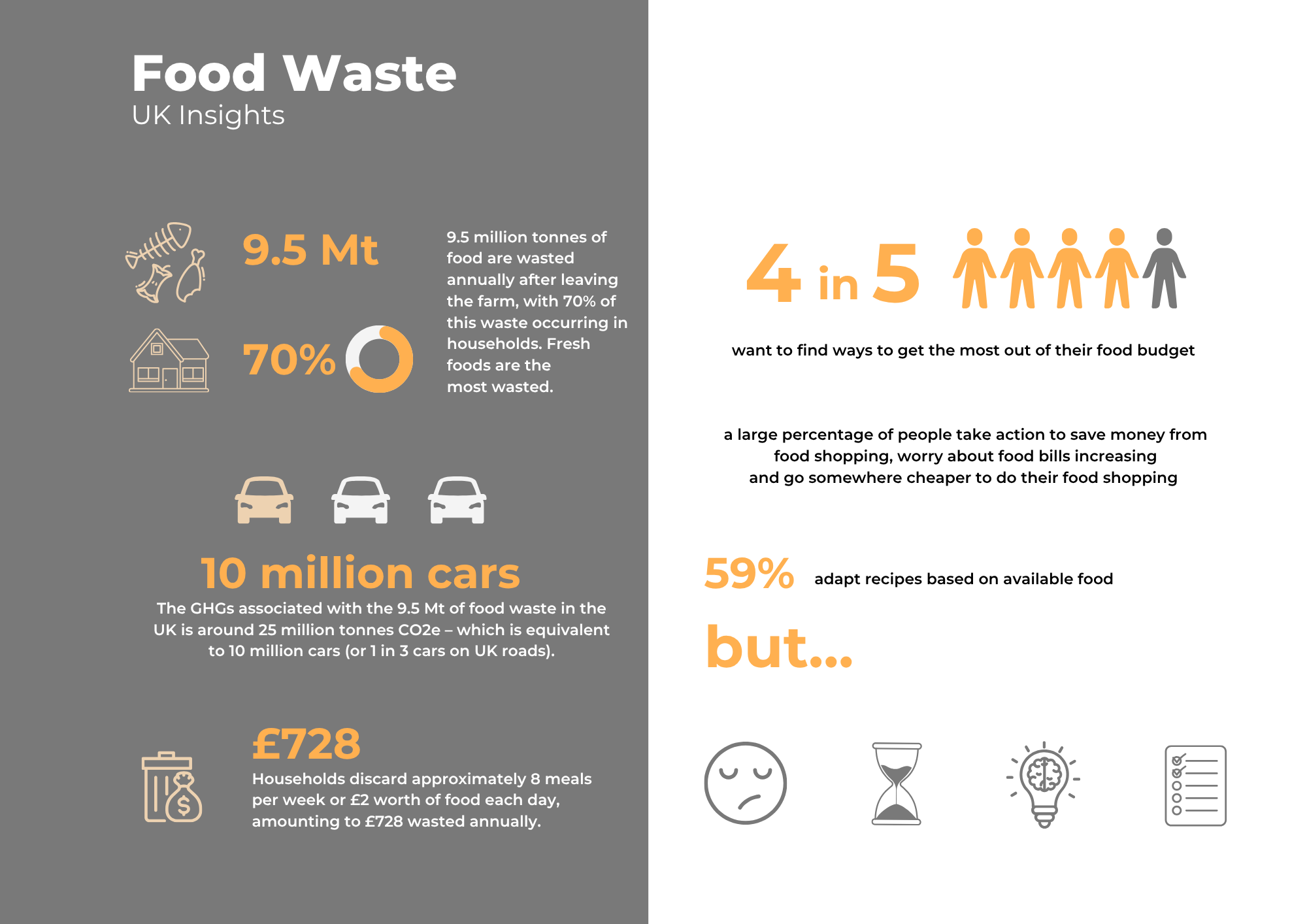
Four insights from desk research and behavioural analysis.
- 01
Food waste is largely behavioural.
Many households already care about reducing waste - they struggle with consistency, planning, and ingredient awareness, not motivation.
- 02
Existing smart systems lack visibility.
Fridge-based tracking systems miss non-refrigerated products - canned foods, dry ingredients, fruits, vegetables.
- 03
Sustainability alone is not enough motivation.
Users adopt sustainable behaviour when it improves convenience, saves money, and reduces mental effort - not when it requires sacrifice.
- 04
Meal planning creates cognitive friction.
Recipe selection, inventory awareness, and shopping coordination are usually disconnected processes.
Work with existing behaviour, not against it.
The project aimed to create a seamless kitchen assistant capable of tracking household inventory, prioritising expiring ingredients, simplifying meal planning, reducing manual organisation, and encouraging sustainable consumption through convenience rather than guilt.
Design goals:
- Reduce household food waste
- Simplify meal planning
- Minimise manual input
- Create approachable smart technology
- Support different dietary needs
- Build an inclusive experience
.png)
Four alternatives, considered and rejected.
- 01
Fridge-integrated systems
Rejected - failed to track non-refrigerated ingredients and created incomplete inventory visibility.
- 02
Cabinet-mounted camera systems
Rejected - installation complexity, scalability issues, inconsistent viewing angles.
- 03
Waste-bin monitoring
Explored as a way to analyse discarded ingredients, but lacked preventative behavioural interaction.
- 04
Community food-sharing systems
Explored as a social sustainability extension, but shifted focus away from household interaction.
Approachable rather than robotic.
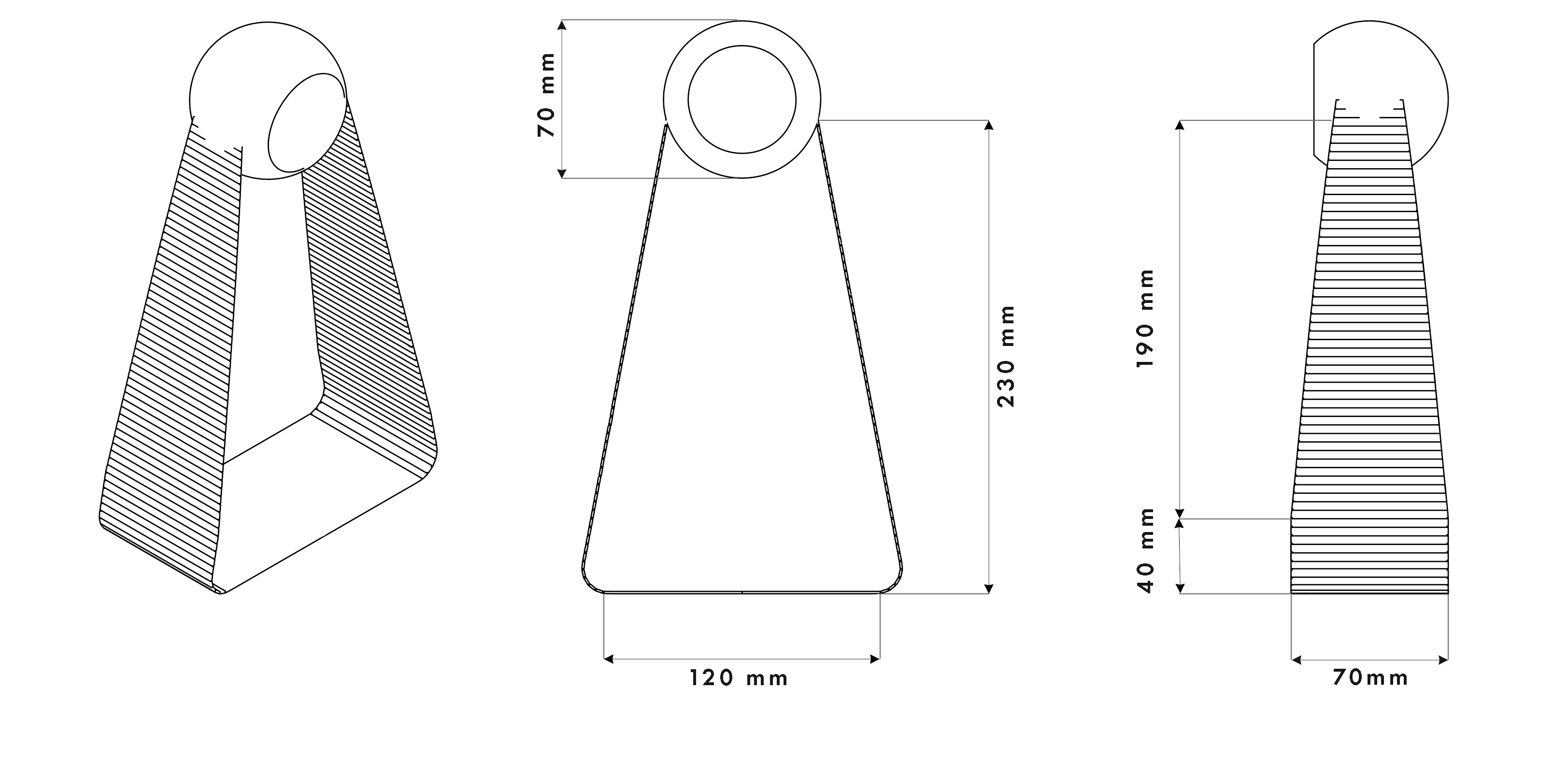
The final form was inspired by luxury watch aesthetics and precision consumer products rather than conventional smart-home devices. The triangular structure provided physical stability while allowing the flexible neck to support adjustable camera positioning and multiple scanning angles.
The elevated camera placement improved visibility across the countertop while maintaining a compact footprint suitable for smaller kitchens.
- 01
Flexible gooseneck structure
Adaptive height and angle adjustment for different countertop layouts.
- 02
Elevated camera system
Improves ingredient visibility and scanning coverage across the surface.
- 03
Compact countertop footprint
Avoids invasive kitchen installation requirements.
- 04
Minimal lifestyle-oriented aesthetic
Designed to integrate naturally into domestic environments not flagged as ‘smart-home’.


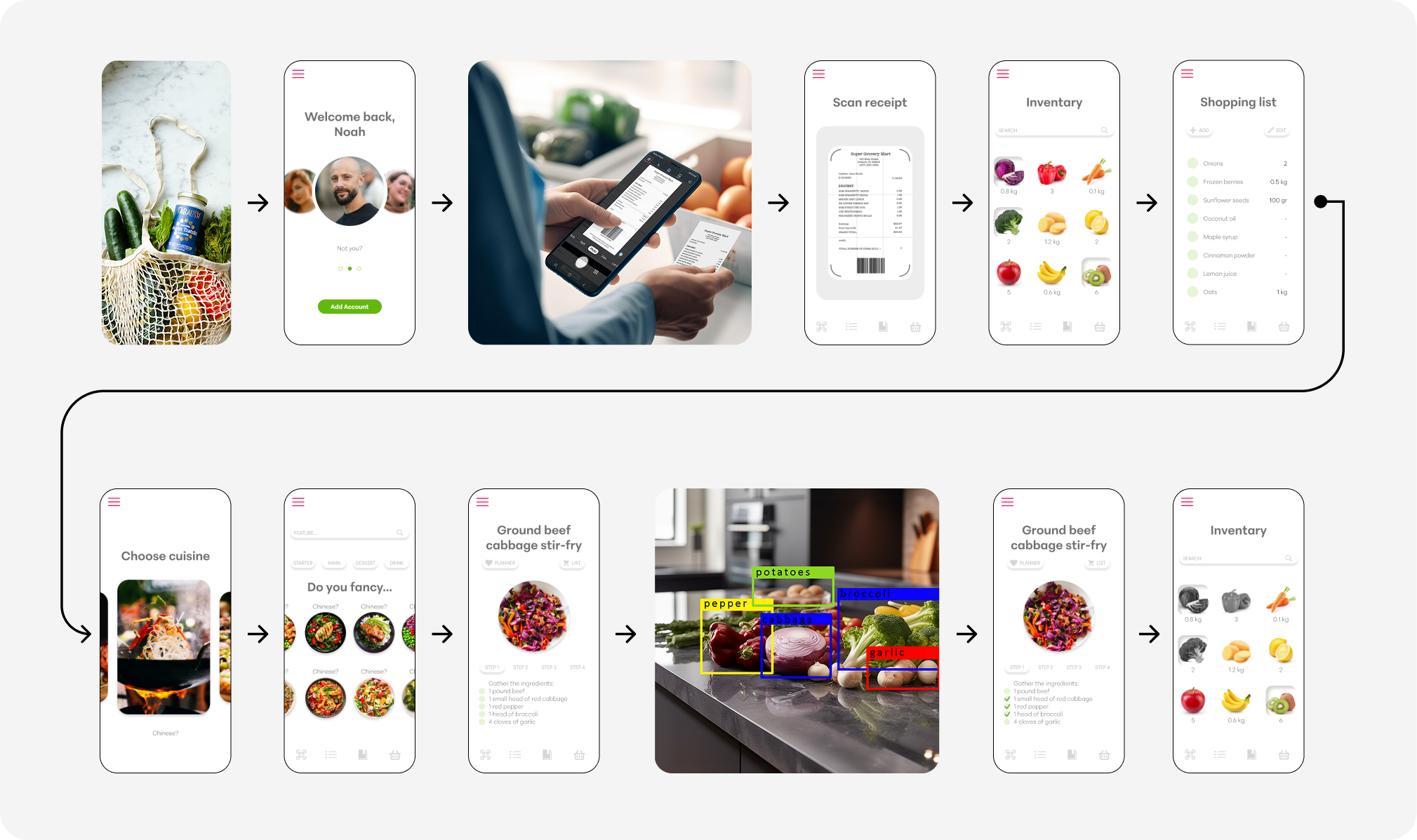
A connected loop, not a standalone appliance.
Rather than functioning as a standalone smart appliance, Sustainable KitchenAI was designed as an interconnected behavioural system linking purchasing, cooking, inventory management, and meal planning into a single adaptive experience.
- 01
Receipt purchase
Everyday shopping continues as normal.
- 02
OCR receipt scanning
Receipt photo → parsed line items via OCR.
- 03
Virtual inventory created
Items appear in the household pantry view.
- 04
Ingredient prioritisation
Expiry and usage frequency rank what to use first.
- 05
Recipe recommendation
Adaptive engine matches recipes to current pantry.
- 06
Cooking interaction
Used ingredients deducted automatically.
- 07
Inventory update + shopping list
Missing items flow into the next shop.
.png)
A seamless flow between physical and digital touchpoints.
- 01
Onboarding & personalisation
Profiles, dietary preferences, and cuisine preferences set up the recommendation engine.
- 02
Inventory management
Ingredients automatically tracked and visualised; manual edits feel light, not punitive.
- 03
Adaptive meal recommendations
Recipes respond dynamically to ingredient availability and freshness.
- 04
Shopping coordination
Missing ingredients are automatically added to shopping lists with one-tap removal.
Speculative ecosystem, prototyped where it counts.
- OCR receipt extraction using Microsoft Power Apps
- AI image recognition model trained to identify ingredients
- Inventory parsing workflows
- Mid-fidelity mobile application prototype
- The full adaptive recommendation engine
- Advanced household learning behaviour
- Long-term predictive meal planning
While the ecosystem was speculative in scope, several core interactions were prototyped to test the feasibility of automated inventory tracking and ingredient recognition.
Convenience and domestic privacy aren’t opposites.
Because the system relies on continuous visual interaction within the home, data privacy became an important design consideration. Users may resist domestic AI systems if they feel constantly monitored or recorded.
Future iterations could explore:
- local on-device processing,
- intentional activation states,
- edge-AI systems,
- temporary image processing without cloud storage,
- clearer user transparency controls.
Designing sustainability around human benefit, not sacrifice.
The project reinforced the idea that solving environmental problems often begins with improving individual daily experiences. Rather than asking users to radically change their behaviour, Sustainable KitchenAI explored how sustainable habits could emerge naturally through convenience, personalisation, and reduced cognitive effort.
It also highlighted the importance of balancing intelligent automation with user trust, privacy, and accessibility.
The project is not simply about food waste. It is about designing behavioural systems that make sustainable actions easier, more intuitive, and more integrated into everyday life.